Angela Graham
I was a documentary maker for decades – images and truth my daily concerns in the business of representing the lives of other people. The three poems in my Poet of the Month feature appear in my new collection, Exposure: war, media, democracy. The book responds to journalistic reports of conflicts – the first half, Soldiers and Civilians engages with the Russian invasion of Ukraine and the Israel / Gaza war; the second, Citizens and Politicians with the operation of democracy, its institutions, its weaknesses and the crucial issue of how the individual can participate.
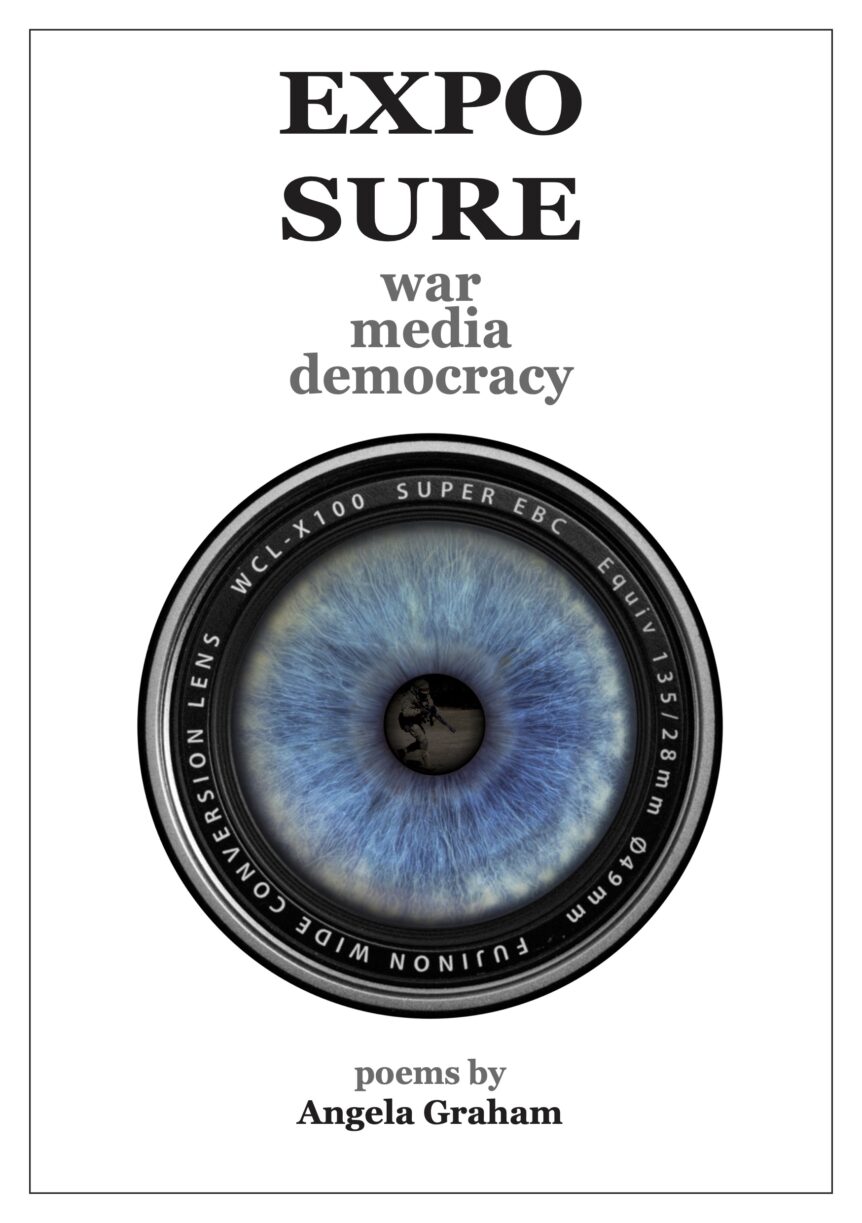
I’ve written poetry from an early age, using words to create images. Perhaps it was inevitable that I would write a book bringing journalism and poetry together. The majority of poems respond to still or moving images.
In organising the 74 poems the importance of the link between image and imagination came to the fore. When we see an image, for instance a photograph of a calamity of war, we do more than merely register an arrangement of pixels or shapes. We allow that image to enter our personal image bank, for good or ill. We have some control over what happens in the alchemy that ferments between the image and our imagination. We ‘process’ the image, connect it with others, and with our experiences. We speculate. We attempt to draw conclusions. We can allow the image to affect us or shut it down. And the reasons why we make choices of this kind can be instructive. Why does this appeal and that appall? Imagination is a crucial element in our life with one another. It can atrophy our horizons or expand them. Photographs, the moving, and the painterly, image are enormously influential in this process.
Journalists and poets work hard to access our inner world. Both employ word and image. The collection examines some of the ways that journalistic images capture reality and how they present or re-present that reality – does what is true from this angle look more true than from that one? If I write a poem which is mellifluous, with striking imagery and confidently assertive but which ultimately falsifies an experience, am I doing something akin to the photographer who manipulates a battlefield photograph to deliver a pathos acceptable to the viewer at home?
There are also poems in which I choose to speak in the persona of someone encountered through the media. Speaking as a Ukrainian or Israeli soldier, for instance, is perhaps a bold move but, I believe, an inherently humane approach; and it’s instinctive to imagine ourselves ‘in someone else’s shoes’, though we can, of course, choose to do the opposite by deliberately blocking engagement.
‘Bombarded City 3’ by Angela Graham
The air has changed. It shrinks from us when we emerge
– the sun a shrivelled leaf, the air thinning.
Even the ants limp and
the cats are eating their own paws.
Buildings lean on one another like exhausted beggars;
salvage – an obscene dream.
This morning I wondered,
Is it time for me to hate myself?
Then I found a teenage boy,
sobbing
where there used to be a doorway.
I put my remaining arm around him.
thelonelycrowd.org/2026/01/25/bombarded-city-3-by-angela-graham/
In one of the three poems featured (‘Bombarded City 3’) I imagine myself as an inhabitant of a bombarded city in Gaza (not necessarily the same individual in both poems). I am writing prompted by an amalgam of news reports but also from my own experience of growing up in Belfast, a much-bombed city. I understand, I hope, that there is a vast difference of degree between these locations and circumstances (I assert no simplistic correspondence) but I respect the validity of what I know from experience about urban attrition, militarisation and relentless precarity.
I am careful to acknowledge in footnotes throughout the collection the source of the prompting image or news report, where possible (radio, tv and online sources also feature and sometimes the same story on multiple platforms) along with the media personnel who produced it. I do this to recognise the media workers but also to stress the collaborative nature of both their work and of the reader’s involvement with and it and with the poem. We are in this together. Reading a poem is more than the act of one person.
I chose not to include source photographs or paintings alongside the poems. The book is therefore in the tradition of photo-poetry (a symbiosis of poem and photograph) but with the photographs deliberately left out. I want it to be the poems, in the immediate instance, that create images in the reader’s imagination – the most personal form of intimacy. References are provided to allow most of the images to be accessed online should a reader wish to do this and to access background information.
The opening poem in the Citizens and Politicians section is a response to a painting: Norman Rockwell’s ‘Murder in Mississippi (Southern Justice)’. This was commissioned by Life magazine in 1965 to accompany an article on the merciless killing of three civil rights workers in 1964. In writing poems prompted by works of art or photographs I usually like to give a sense of the appearance of the work though this is not essential to ekphrastic poetry. I find the discipline of conveying at least the essentials of a painting sharpens my perception of it because analysis of the techniques used helps me appreciate what the artist found important (the same holds true for photographs and films). Elements such as Point Of View, colour choice, composition, relative size of elements, framing (what’s included or excluded) each of these is a word which I hear and re-express in new combinations via words of my own.
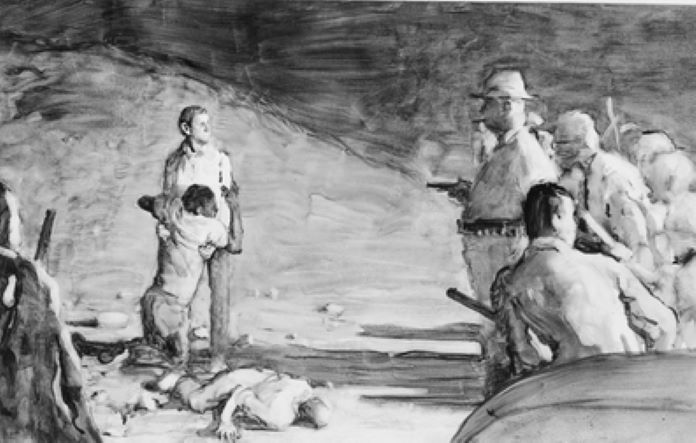
The research for these poems has been fascinating and the Norman Rockwell poem is an excellent example. Rockwell was, and remains, well-known for his hyper-realistic depictions of moments of American mid-twentieth-century life at its sweetest: intimate family moments, gentle domestic comedy, neighbourliness – but with almost no Black people included. Rockwell declared that after painting this Mississippi work he could no longer produce the apple-pie America that had been his forte for decades. His engagement with the reality of racism changed his artistic practice. See also his famous 1964 painting ‘The Problem We All Live With’, for Look magazine.
Finally, a note on form. The Mississippi poem is in three-line stanzas and the Gaza poem in two six-line stanzas. The emotional content needs a supporting structure. In contrast, the neutral, business-like title, ‘A Plan for the Development of Gaza’ opens with the line posing that question, ‘What does the sand feel?’, rather like a reasonable focus-group leader wanting to be inclusive, but it must be followed by the effect of accumulation, of billowing, unstoppable, overwhelming momentum therefore clauses accumulate up to the blunt, ‘The sand feels nothing.’ followed by an uncompromising emphasis. I needed a single stanza, a tight room in which to hold, and thereby magnify, the impact of my depiction of this outrageous, chilling, human-made, deliberate and dispassionately calculated catastrophe.
Angela Graham was a runner-up in the 2025 Seamus Heaney Award for New Writing. Culture & Democracy Press will publish her third poetry collection, Exposure, 75 poems on war, media and democracy in February 2026, having published her second, Star in 2024. Her 2022 poetry collection, Sanctuary: There Must Be Somewhere and 2020 short stories, A City Burning (Edge Hill Prize longlisted), are from Seren Books. Angela is from Northern Ireland. She won the Poetry Prize in the inaugural Linen Hall Ulster-Scots Writing Competition, 2021. She has had an award-winning career as a film maker and screenwriter in Wales. In 2022 she received an Honorary Life Fellowship from the Institute of Welsh Affairs for her work on media and democracy.
To see more of Angela Graham’s work or to order her latest collection see the links below


