You took over a festival with a history and a particular orientation but you are the Festival Director now. What differences or changes have emerged since you took over the role?
When I took up the post 18 months ago, October 2024, the headliners were already in place and Peter O’Neill, who was the driving force behind the festival, stayed on as Executive Producer. He was very generous, but he also said that he would step back as much as I needed him to, because he felt that I needed to take ownership of the festival and he understood that it was very difficult to take over from a founding director of a long running festival.
We worked well together, and I built up a lot of confidence during that period. If I look back on it, I learned a lot of lessons and we produced a very successful festival, and I certainly felt that I gained a lot of experience being part of the festival’s curation, almost, from start to finish, and then Peter finished up at the end of March Last year.
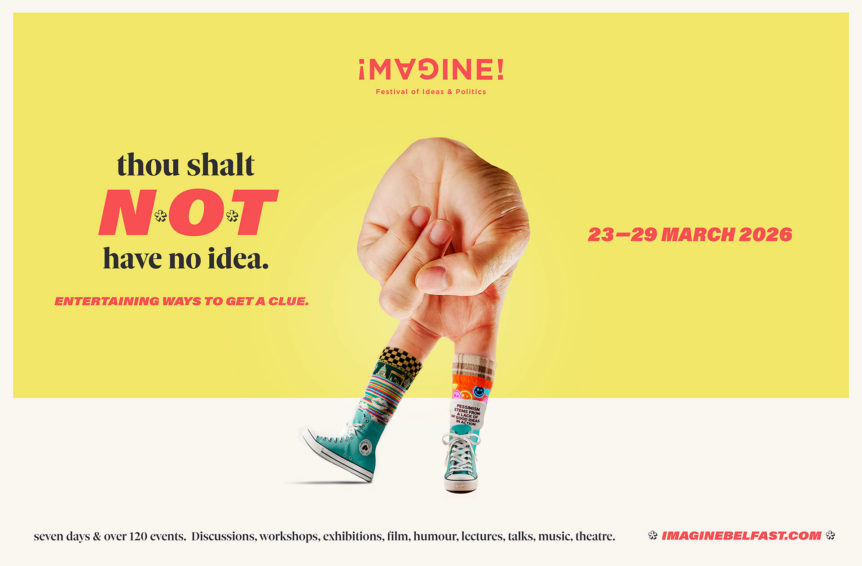
I expect the basic elements of the festival are still in place?
The festival still has over 70 per cent of the events coming from the community in an open submission process and that is a vital part of our orientation.
I think over the last few years culture has changed massively, particularly in the last few years, so when we looked over the open submission process this year there was a sense of provocation in a few of the submissions rather than a starting point of open discussion or enquiry.
There is also a sense that we were looking at the question of censorship in the arts and there were a few submissions, from outside of this country, which were coming at the issue from the point of view of “Political Correctness Gone Mad” or “You can’t say anything any more” and they just didn’t feel particularly persuasive or investigative. I have no problem with provocation, and the Imagine Belfast Festival has never excluded people, but this seemed like a different approach entirely.
What made you think that?
This festival works on the basis of respectful discussion and debate and we want people to be able to feel that they can be part of our events where debate can be had, there may be disagreement but it is respectful disagreement, and you go on from there.
It is essential to conduct thorough due diligence on submissions to ensure they align with inclusive values and avoid harmful rhetoric. In the current social climate, certain exclusionary narratives that were once relegated to the fringes are becoming more overt. A small minority of this year’s submissions reflected this shift, requiring a more rigorous vetting process to filter out divisive discourses that have become increasingly prevalent compared to previous years.
So, there are changes in the cultural discourse which we have to factor in while we maintain our community connection. It is important that ordinary people, and the ideas and concepts they want to discuss and debate, are represented through the Imagine Belfast Festival. The aim is still to challenge us all to think slightly differently about things.
To see the full programme go to the link below


