How did you discover poetry as a form of self-expression?
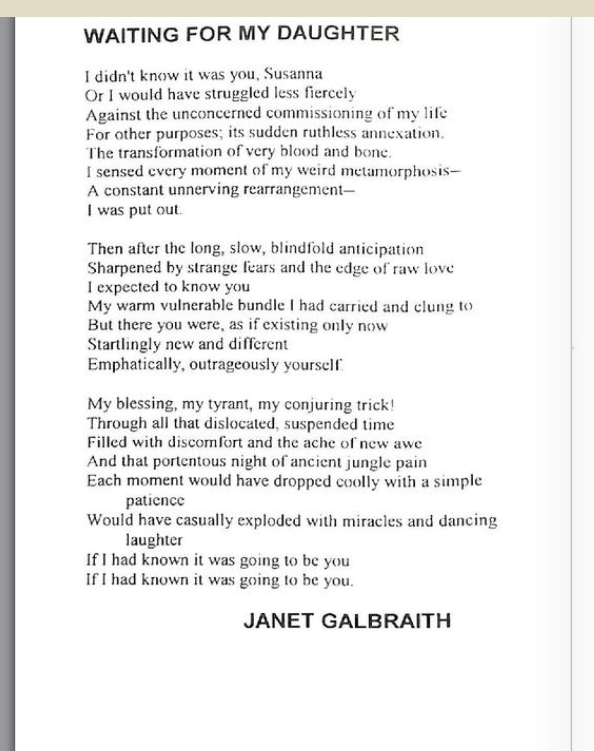
In my own life, poetry was available to me as a thing I might consider doing because my mum wrote poetry. So I was aware of it as something that you just needed a notebook for. It seemed as natural a thing to imitate as brushing your hair, or turning the oven on. It was just there.
But as to why I keep doing it… I would say that working with poetry demands that you pay attention to the world in a way that is different from any other medium. It’s the wrestling with language, permitting yourself to spend a lot of time doing that. And the ability to play with wide spaces, with silence. The scale and potential of poetry is more appealing to me and that is why I always come back to it.
Did you get support at, home or at school?
I was fairly lucky in a lot of ways. Both of my parents respected the arts and my mum had her own poetry practice. In primary school my P7 teacher gave me side projects where I had to find images and write about them. It was just my own little project, because I suppose he saw something in my interest. I am very grateful for that support.
As a teenager I wasn’t actually a great reader, more interested in music at that time. But I did write poetry. My teacher (now a very highly renowned fiction writer, as it happens, but always a brilliant teacher) put one of my poems up on her filing cabinet. That encouragement and validation was important.
I’ve actually just finished training as a teacher, and these small but important gestures are often in my mind.
You went on to study English at Trinity?
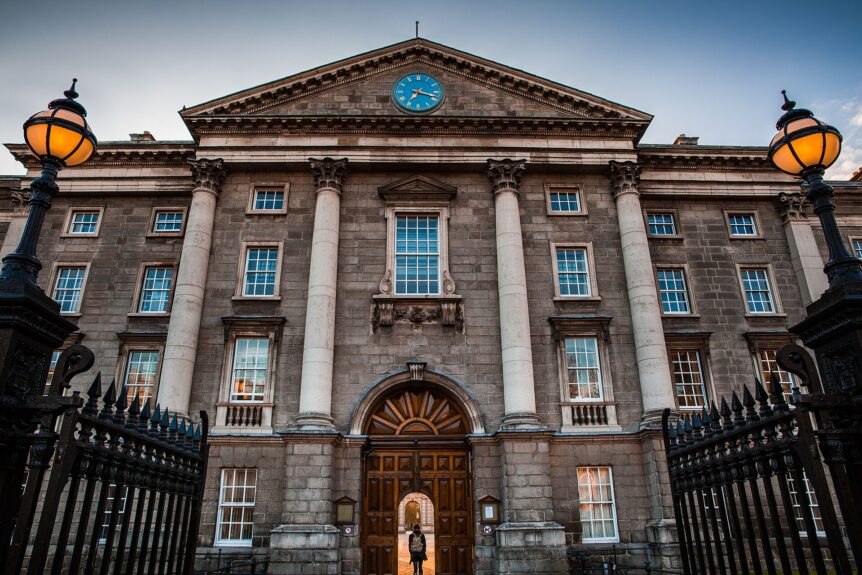
Yes – mostly literature, with a bit of the history of the language. There was no creative writing element. I was involved with workshops which were adjacent to the university, or fringe, amongst the students, and then with publications, editing Icarus for example, and then the Journal of Literary Translation. So there was a community of people with a creative practice that I was connected to when I was there.
After that I switched to Art History for a while, completing an MA in University of York.
How do you develop your craft?
First of all, I have to say that my commitment to developing my craft has been very hot and cold over a period of fifteen years or so; I have drifted in and out of writing poetry, although I am committed now.
In terms of ‘developing the craft’, it was a combination of things, I would say. When you are studying literature you are analysing the mechanics of writing, looking at what a text is, what it is being communicated, how and why, what imagery is being used to convey ideas, etc. You develop a process of slow reading and taking in and assessing information about writing. So that’s been part of it.
Then there is being involved with any creative community where you develop relationships which allow you to have long conversations about craft and technique, learning from that process.
From 2020 I started attending workshops. I went to a summer school with The Stinging Fly in 2021, and the Seamus Heaney Summer School in 2023, and those were very useful. Workshops like that returned me to a process of figuring out how to make decisions about my own work, and see what it was I was trying to do with my writing.
I also did the New Voices North mentorship last year and I was part of Poetry Ireland Introductions as well, and a couple of other small mentorships.
When it came to writing morsels, I worked with a team of amazing editors, and two editors who were focused on my work, which was brilliant. That allowed me to see, between their thoughts, exactly what it was I was trying to achieve. That triangulation process was really useful.
Do you have any influences on your work?
Louise Glück is an influence on my approach. I am very interested in cumulative meaning and her collections have ostensibly simple poems which return to the same images and build up a narrative.
When I was studying, Lyn Hejinian and her book “My Life” was something which had a substantial impact on me. Later, when I was not studying or attending workshops, Ocean Vuong was someone whose writing seemed quite transformative to me in terms of craft, and – perhaps on the other side of things, Mary Ruefle and Lydia Davis. I read a lot of fairytales as I was writing morsels, and lots of different works in translation. Carol Mavor, art historian, has also definitely influenced my thought. And I read lots of emerging Irish poets. There are influences I’m not aware of. There are so many things that seep in.
If you would like to see more of Susanna Galbraith’s work


