Once you have the information, how did you go about making the artwork?
Gemma
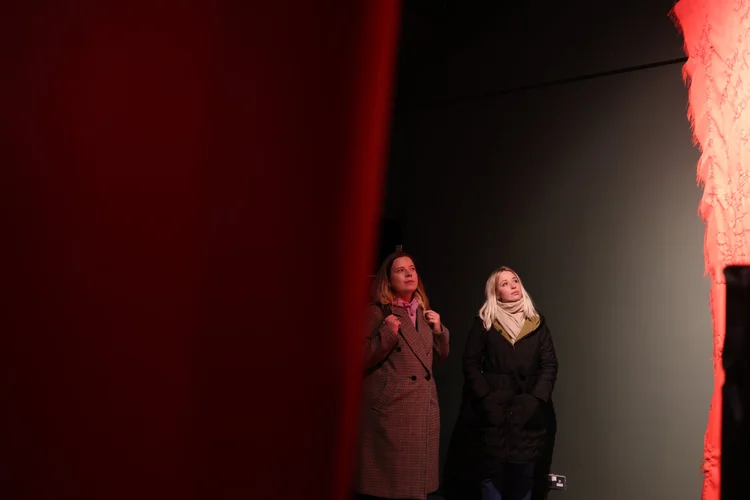
I think it came together quite organically. We had some immediate ideas. Red Flags was something that stood out straight away. The room was filled with Red Flags. They are pennant shaped flags because that was the most efficient way of using the material we had.
We used a devised theatre practice to begin with. We firstly devised a meditation and we would lay on the ground, meditate and listen to the podcast. We would then get up and take notes and then share the notes we had taken and look for things which kept emerging from that process.
We kept coming back to certain phrases. “Bag of Excuses” was a phrase that Jane Monckton-Smith used to describe all the excuses that men would use which she heard time and time again:
“she was depressed, she kept nagging me, I felt suicidal, I wanted to kill myself but then she committed suicide,”
all of these arguments that these men would make to mitigate their behaviour.
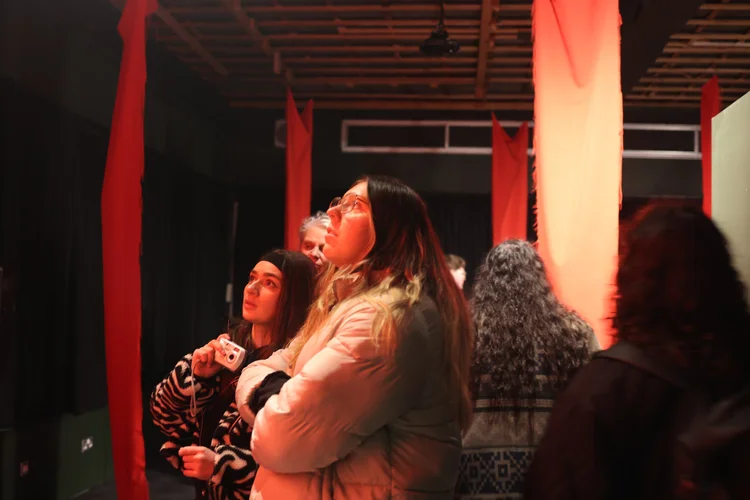
We did go through various ideas of how the installation might look, and we played with different ideas, and we were aware, by that stage, of each other’s practice. We knew we wanted to do something with sound, we experimented with Keening, and we talked about doing something with some kind of set, and that eventually became part of the installation.
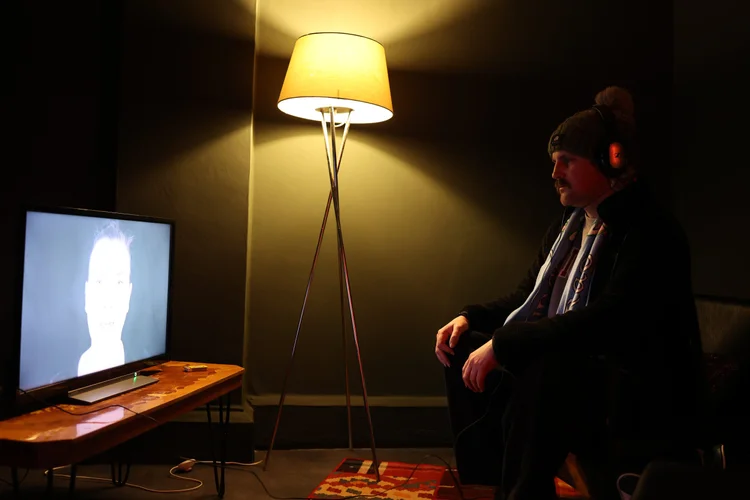
The video was quite interesting, because we talked about what it should look like, and I went into my studio late one night and pulled something together. I kept humming and hawing about the video because it was so confronting. I thought it was too, “on the nose”. Sinead was much less concerned about that.
You were really thinking through how the artwork had to be presented?
Gemma
We were playing with really obvious ideas like what a battered woman is, and that is why the face (on the video) at times looks very beaten, because that is what people expect. It is very provocative, but we talked a lot about how battered women are portrayed in popular culture, like cop shows, where they are always gorgeous, young and “sexy”, always attractive, but beaten and dead.
We came to the conclusion that the video had to be provocative. The other parts of the exhibition might be open to interpretation, but the video, which we carefully wrote out what the text was going to be, had to be provocative, and it had to be very clear.
I don’t have much to add to that. I think that is a pretty fair reflection of the process.
We did discuss the possibility of the video being in a separate room, and we were thinking a lot about using a set, because I have used sets within my work before, and I liked the idea of creating some sense of space and putting objects that mean something to people, that hold memory for people, in that space.
I have seen how Gemma’s Amadan Ensemble has used sets as well. I thought the way they worked was very interesting.
The use of sound was something we discussed and so using sound as part of the installation developed as we went along and I think it really worked well for us.
What about financing the installation?
Sinead
In the beginning, a lot of what we were doing was budget dependent. We didn’t have a budget for buying anything, so buying the red material didn’t cost much and creating the video was inexpensive, and having me layering up the sound was good for us financially as well. The idea of people speaking in their normal voices, saying things without acting; we thought might connect with people.
So, the process of discussion and working through ideas, allowed us to develop something which is very thought provoking, and that has certainly been the feedback people have given us after they have been through the installation.
To see more of the work of Gemma Mae Halligan and Sinéad O’Neill-Nicholl


