Was it daunting to be asked to work on a cross genre project, one that required acting as well as dance?
Talitha
Actually, one of the first projects I worked on in Australia had text in it. Now it wasn’t dramatic, but we were speaking. In my experience, it is not uncommon to have dialogue in dance projects. Maybe that happens more in Australia than in other places.
As my career has gone along in Australia, there hasn’t really been any other option, especially in Perth, but to work on multi-disciplinary projects. In fact recently I have been working more with theatre makers than with dancers, so that side of it wasn’t that daunting. I am able to remember lines and do text and movement together.
What about developing the character?
Talitha
As I said earlier, we talked a lot creating a character and then we would run through some improvisations using movement to express the feelings and ideas of that character. We would layer in the text afterwards.
I’m not a trained actress and because the text is so prominent, and because I am on stage alone most of the time, delivering the lines, I had to work quite hard to enunciate my words. I had to make sure I could give emotion to the words as well as with my body.
You used your previous experiences plus online discussions to develop your side of the project?
Because we did it online first, and we spent a lot of time going over the feelings and emotions of the character, when we finally got into the studio we could really use the time to physicalize and marry the two strands together.
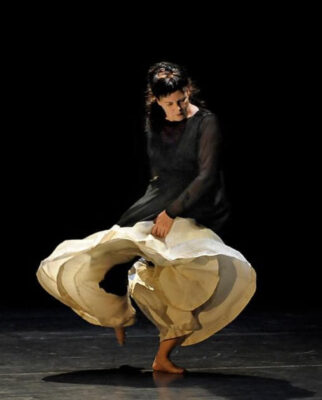
Photograph Courtesy of Alistair Livingstone – Chrissie Parrott
Sometimes, when I see dance with text, it doesn’t integrate very well, it seems disjointed especially when the dancers are executing really languid, beautiful, poetic movements. Those movements can send people into a dream state, and then when the dialogue is added, when the words are spoken, the whole atmosphere is changed. It quite often cuts through the realness of the dance.
I wanted to know the words well enough, I wanted to be able to say those words, but as just another movement. I wanted the performance to be seamless and I wanted it be theatrical, not just an interpretative dance piece.
The woman I work with, Chrissie Parrott, who knows Alistair, often starts with text and we will interpret the text through movement, so it isn’t new to me. I think that is why we were able to pull something together quite quickly.
Alistair
I did have reservations initially that Talitha’s Australian accent might be a problem wit. But, by the time of the showcase at Ulster University, she had practically lost it. I had no worries and her performance and dialogue were highly praised.
To see more of the work of Alistair Livingstone and Talitha Maslin go to the links below


