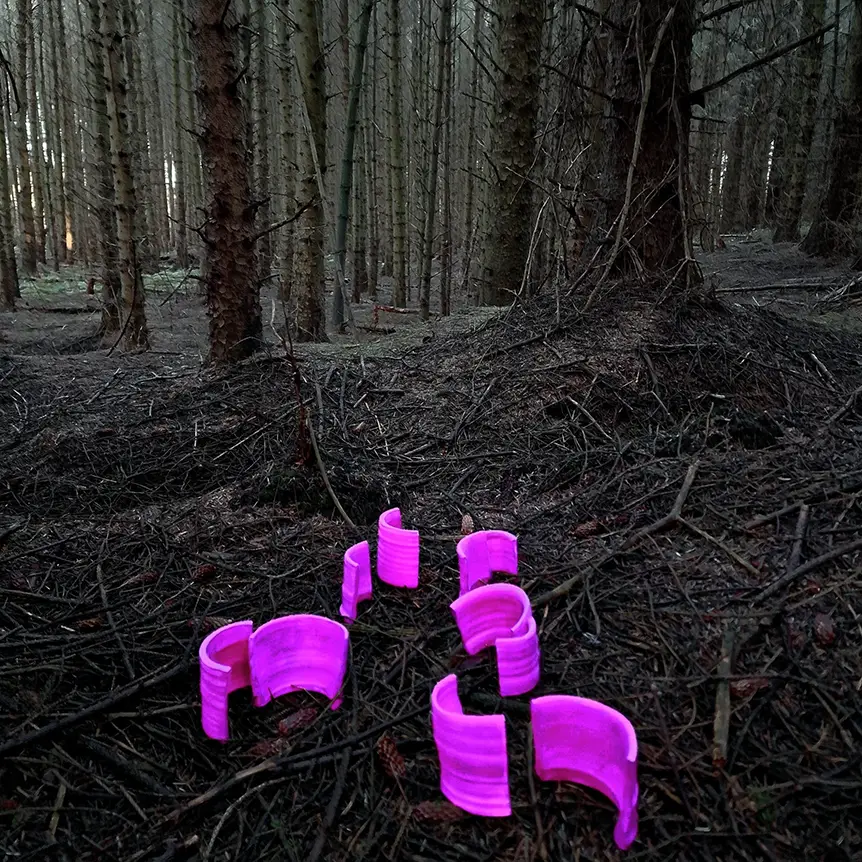
Sitting between land art and landscape photography, Lowry creates temporary, often barely legible interventions that exist for a moment before disappearing back into the terrain. Lowry’s practice does not offer solutions. It asks viewers to stand briefly, on borrowed ground and to recognise the ripple effects of enclosure, extraction, and conflict. In these fleeting interventions, the land is allowed to speak, quietly, about what has been taken and what continues to endure.
Her interest in the commodification of land is inseparable from the legacy of Common Land laws and the slow privatisation of what was once shared. In Lowry’s work, land is not simply owned or occupied; it is negotiated, contested, and remembered.
Folklore and cultural heritage surface as quiet undercurrents, suggesting that what disappears is not only physical territory but collective knowledge and ways of living with the land. While her work has been widely exhibited and recognised internationally, it retains a grounded intimacy and a private lament for the land. Whether responding to museum collections or working directly in open landscapes, Lowry treats each site as a collaborator rather than a backdrop. Her current residency at Armagh County Museum extends this approach, bringing historical artefacts into conversation with living land and contemporary ecological concern.
Lowry’s interventions are often carried out on both public and private ground, sometimes sanctioned, sometimes not. This refusal of clear permission mirrors the questions her work raises: who decides how land is used protected, or erased? She often makes her work on land accessed through gaps in fences, by climbing over walls, by fleeting opportunities provided for installing personal memorials. The temporary nature of her installations echoes the precarity of the environments she responds to, as well as the instability of access itself.
Lowry’s practice does not offer solutions. It asks viewers to stand briefly, on borrowed ground and to recognise the ripple effects of enclosure, extraction, and conflict. In these fleeting interventions, the land is allowed to speak, quietly, about what has been taken and what continues to endure.
More information: www.belfastexposed.org/whats-on/rosalind-lowry/


