Recently we received an email from Rana O’Brien from High Points Youth Ballet which contained a review of Ballet Ireland’s new production of Romeo and Juliet. We asked Rana if we could post the review in The Monthly – you can see the review below – but first you can find Rana’s Substack at the following link.
spargovoluptas518112.substack.com/p/romeo-and-juliette-ballet-ireland
Ballet Ireland’s production of Romeo and Juliet is on tour right a cross the island – You can see dates and venues at the link below
www.balletireland.ie/whats-on/romeo-and-juliet/
Romeo and Juliet is a story etched into the very soul of humanity: a world in which love and hatred, tenderness and brutality, loyalty and betrayal exist in constant, often devastating opposition. Conflict is not merely the backdrop against which this tragedy unfolds; it becomes almost a state of being, an inescapable force that consumes individuals, families and an entire society.
Morgann Runacre-Temple’s interpretation of Romeo & Juliet unfolds within the walls of a school, an institution supposedly devoted to educating, civilising and nurturing young people into better human beings. Shakespeare’s tragedy becomes the subject of the classroom, yet the classroom itself bears an uncanny resemblance to the world of the tragedy. There is a delicious, uncomfortable irony here: the students, and perhaps even the teachers cast in the roles of the Nurse and Friar Laurence, seem unable to recognise their own reflection in the mirror Shakespeare holds before them. The very institution entrusted with shaping young minds becomes a microcosm of the prejudices, hierarchies and power struggles that lie at the heart of the tragedy.
Shakespeare possessed an extraordinary ability to penetrate the complexities of human nature, exposing its hypocrisies, its irrationalities and its capacity for both profound love and destructive cruelty. What makes Romeo and Juliet so enduring is not simply the tragedy of two young lovers, but the uncomfortable recognition of ourselves within it.
Prokofiev’s score is a masterpiece of emotional storytelling. Fragility is woven into its music, often wrapped in the cruel, sharp edges of its orchestration. Can the anguish of a mother’s scream be expressed more profoundly than through his music? Can the innocence and playful spirit of a young girl be captured more delicately? The flutes, the brass, the woodwind: each section seems to possess its own dramatic voice. Prokofiev was a master storyteller, translating human emotion into a musical language of extraordinary complexity. For any choreographer fortunate enough to work with this composition, the score offers an almost inexhaustible source of inspiration.
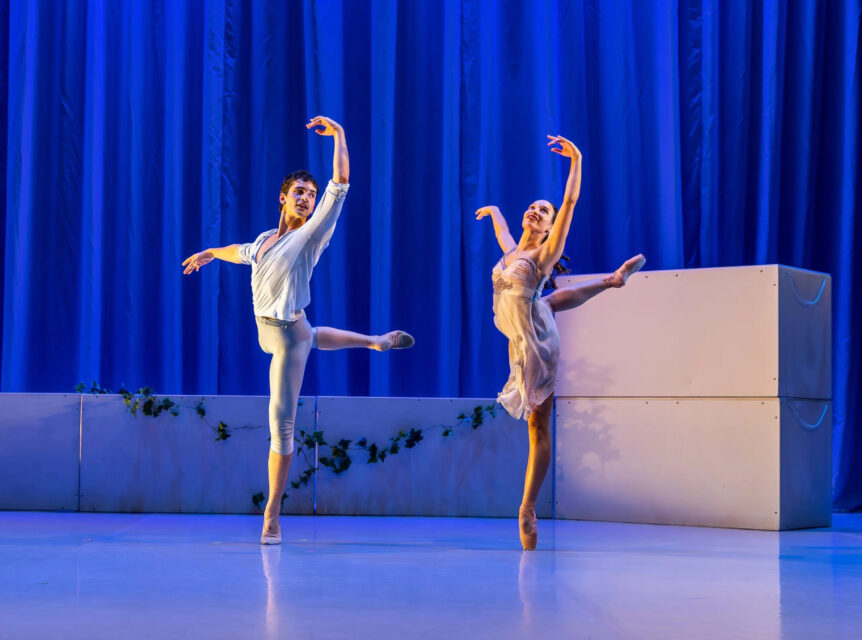
Runacre-Temple draws deeply from this extraordinary musical landscape, translating its emotional contrasts into a distinctive physical vocabulary. Elbows and knees, angular lines and edgy, fractured shapes, rigidly extended, threatening arms become expressions of authoritarianism, oppression and the ever-watchful, controlling gaze. The body appears constrained, guarded and sometimes almost imprisoned by the structures surrounding it. In striking contrast, the choreography opens into expansive, flowing arms, breathtaking lifts, spins and moments of elevation and suspension. These moments of physical freedom evoke attraction, tenderness and the intoxicating possibility of love, but also the vulnerability and hopelessness of two young people suspended between their own desires and the weight of social expectations.
The use of tables throughout the choreography is particularly successful. Initially, they are simply classroom desks, but as the work unfolds, they transform into walls, hedges, doorways, pathways and balconies – whatever the storytelling requires. Runacre-Temple uses them with remarkable ingenuity and imagination. At times, the tables become an integral part of the choreography itself, adding another physical dimension to the movement and even enriching the dynamics of a fight scene. It is a wonderfully inventive use of simple objects, demonstrating how much can be achieved through creative thinking rather than elaborate stage machinery.
Zia Bergin-Holly’s lighting design is equally successful in creating atmosphere. The use of side lighting from the booms does much more than illuminate the dancers; it introduces colour, depth and dramatic texture, complementing the choreography beautifully. Sheer curtains evoke the secrecy surrounding Romeo and Juliet’s wedding, while carefully defined blocks of light divide the stage into different rooms and locations. Within these shifting spaces, the tables become almost magical theatrical layers, continually transforming the environment around the dancers. There is also something particularly admirable about this approach from a touring company’s perspective. Such imaginative use of relatively simple stage elements is far more practical and economical than cumbersome sets that are expensive to build, transport and store. Congratulations to the creative team for demonstrating that theatrical ingenuity need not depend on elaborate production resources.
There was, however, one moment when I felt the physical language of the choreography fell short of the extraordinary power of Prokofiev’s music. In the scene following Tybalt’s death, Lady Capulet grieves for her murdered son. The music alone is enough to send shivers down your spine, yet I sensed that Runacre-Temple was wrestling with an interesting contradiction: how does one portray the devastating grief of a mother who has otherwise been presented as authoritarian and manipulative? Can an autocratic, controlling personality also experience such overwhelming emotional devastation? Of course it can. Perhaps this is precisely the contradiction Shakespeare would have wanted us to confront.
Niamh O’Flannagain’s performance was convincing throughout much of the production, but I felt this particular scene did not quite reach the emotional intensity demanded by the music. There were spasms and physical expressions of anguish, but I wanted something more expansive, more uninhibited, perhaps even more desperate. This was a moment when the choreography could have allowed the body to surrender completely to grief, with larger, more visceral movements responding to the almost unbearable emotional force of Prokofiev’s composition. I found myself longing for a physical expression that would match the music’s devastating power.
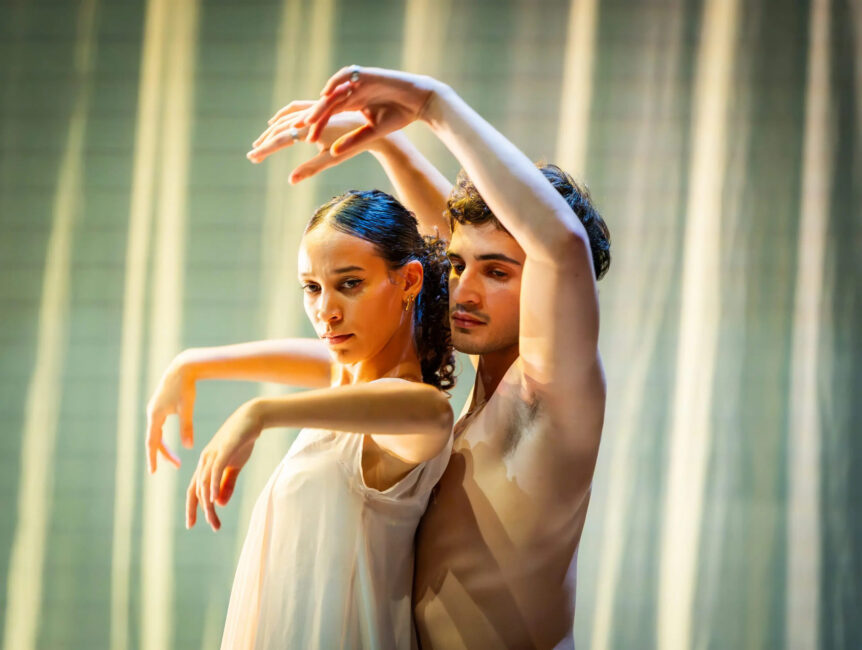
Ballet Ireland must be immensely proud of its professional dancers. Ramón Valls Barba and Erica Vadelka were deeply moving, delivering the emotionally charged choreography with excellent technique, virtuosity and thoroughly convincing acting. What impressed me most was that their virtuosity was not demonstrated through a succession of multiple pirouettes or spectacular, sky-rocketing jumps. Instead, it was in the uninterrupted flow of their lifts, turns and runs, travelling through every corner of the stage without a hint of hesitation or disruption. Their long balcony scene was particularly beautiful. The attraction, the innocence, the discovery of love and the irresistible force drawing these two young people together were expressed with such purity and sensitivity that it would have been difficult to imagine a more moving interpretation.
Igor Person and Koharu Numamoto, portraying the schoolteachers and taking on the roles of Friar Laurence and the Nurse, brought great skill and versatility to their characters. Josh Fagan was a particularly impressive Mercutio, while Luc Burns and Unai Celis Peribanez, as Benvolio and Balthasar, demonstrated not only excellent acting but also remarkable unison and harmony in their dancing, doing full justice to the choreographer’s work. Oisin Middleton made a compelling Tybalt, bringing athleticism and presence to the role, while Roman Pascoli was a strikingly tall and elegant Paris.
It was a real pleasure to see these two performances at Theatre at The Mill, at the very beginning of the company’s tour. We wish Ballet Ireland every success and hope that audiences fill the auditoriums throughout the remainder of the tour, which runs until mid-December.
May the wind be behind you, and may every stage you encounter help you elevate the art of dance on this island.
Rana O’Brien


