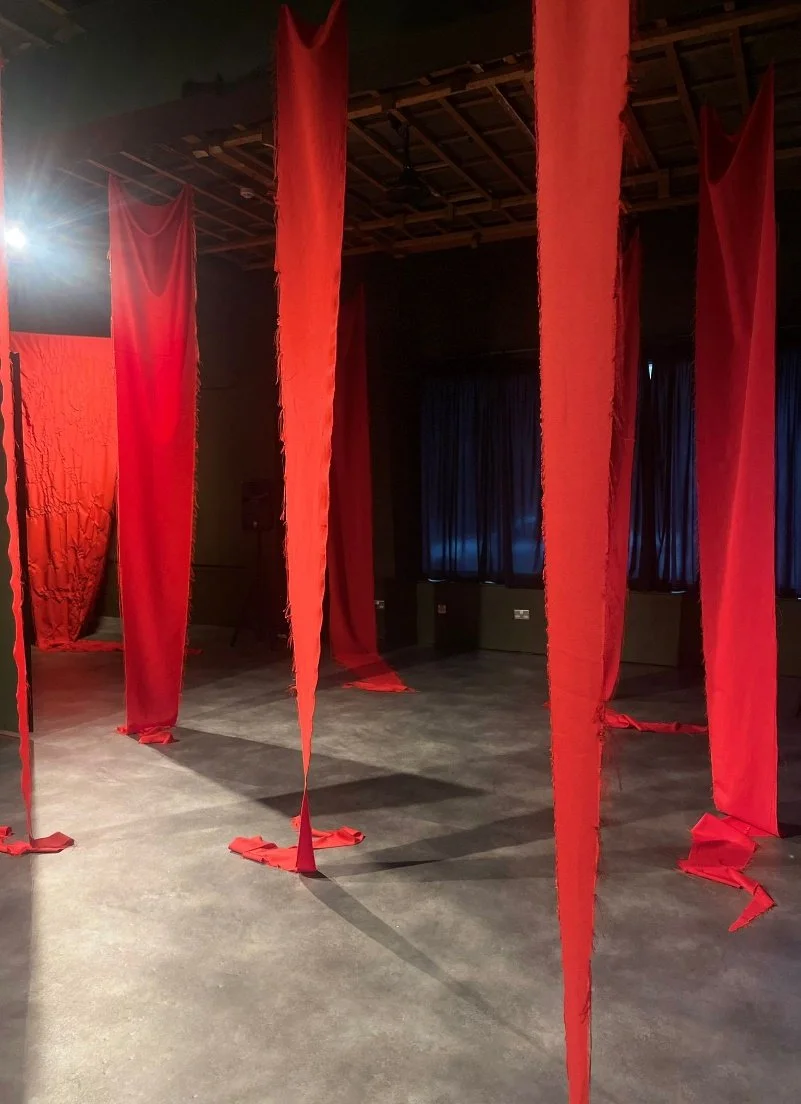
Once you discover the podcast how do you go about creating the installation?
Sinead
I think we both felt that this information needed to be shared further. The podcast is so well done in connecting the analysis to the eight cases here, you get to hear people speaking as it flips between the people who are involved, and it talks about the situations in a way which isn’t just the dry application of the theory.
The podcast points out all the little bits in between the theory, all the nuances, all the examples of different situations, and it also shows how at various points behaviour by these men might manifest in this particular way.
One thing which came up for me was for example was that young people talk a lot about Love-Bombing, they also talk about Red Flags, everything is a Red Flag, but the normalisation of that language might have helped to downplay the seriousness of these steps in a coercive and controlling relationship.
It is part of the learning that you need to know what these terms actually mean so that you can identify what Love-Bombing actually is, how serious Red Flags are, and how these patterns fit into a series of steps which end in the murder of women.
Gemma
That comes back to that idea of, “How do we not know this?” Part of the beauty of that podcast is it very clearly sets out, in a way which is easy to digest, the modus operandi of someone who is a controlling and abusive person. You can see how everything builds, step by step, one experience on top of another.
All of those arguments, those myths that we have accepted as a society, which excuse this behaviour,
“It was just a red mist, it just happened all of a sudden, it was a crime of passion, you never really know what goes on between two people, what did she do to provoke that situation, it takes two people to party,”
all of that kind of thinking, which completely negates all of what happens in a relationship with a highly controlling person and in that situation all bets are off.
It is incredibly difficult to get out of that cycle, and the person who is the focus of that controlling person, to outside eyes it can appear as if they aren’t doing anything to get out of the relationship. It can seem to other people incredibly frustrating. And these myths make it harder to address that situation.
When women are in those types of relationships they are often cut off at the knees where there is very little opportunity to remove yourself from it. It can seem to outside eyes that you are not doing anything about it.
I have been in that situation myself, I found myself looking at those stages and then comparing what happened in my life, and thinking then how terrifying that situation actually was.
I felt really trapped, but just didn’t have the language to express or explain what the very real problems were.
Now, with this information from Jane Monckton-Smith, you can say that it was XYZ, you can explain these situations, you can explain exactly what is happening, what the relationship actually is and so people can’t just say, “It was all in your mind,” or “it was just jealousy” or “It is just because he loves you so much.”
Sinead
I’m just thinking through how these kind of tropes, these excuses, these myths, seem to work. When someone asks the question, “Why did she not leave?” well, maybe he had control over her finances which meant she couldn’t just leave. Or he told her that if she left she would kill her and her and the kids. That is why she couldn’t leave.
It could be that many people are looking at these women’s lives through the prism of their own life, and that makes it very difficult to see just how awful the situation could be.
There needs to be an understanding that sometimes there are differences in certain relationships, not all relationships are “partnerships of equals”, and coercive and controlling relationships are not that at all. Not all people are in relationships where one partner is trying to the other pregnant really quickly, trying to isolate them from their family, trying to control what they wear, control their finances.
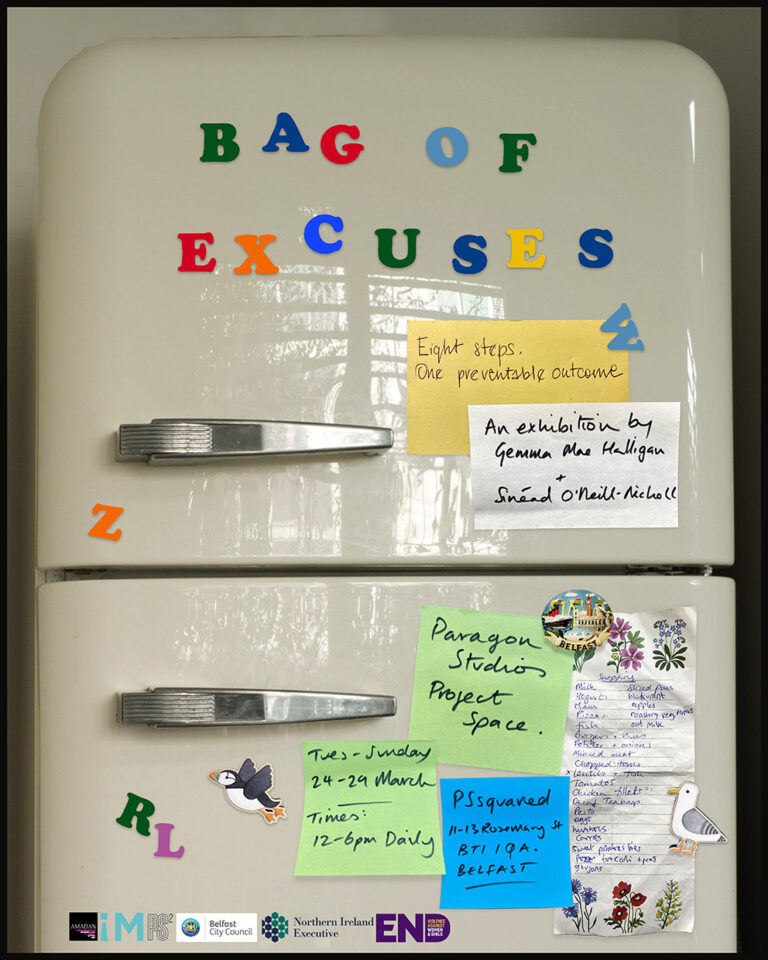
And that means that you are required to look at situations objectively and the information in the podcast, and now our exhibition, offers you a way to do that.
To see more of the work of Gemma Mae Halligan and Sinéad O’Neill-Nicholl


